
July 3, 2026 · Updated September 29, 2026 · Mailbox & Mail
Receiving Packages in Paraguay: DHL, USPS, Couriers, and How to Avoid Customs Surprises
Shipping to Paraguay: what DHL charges before delivery, where a USPS package ends up, what customs waives under US$100, and how a mailbox receives and forwards it.
Short answer: yes, a DHL package to Paraguay can carry customs duties, and DHL will ask you to pay them before it delivers — you get a link by email or text, you pay, the box moves. A package sent through USPS (or any national post) doesn’t get that treatment: it’s handed to Paraguay’s postal service, and unless it’s very light it ends up at the postal service’s office in downtown Asunción, where the recipient — or we, on your behalf — collects it and pays a small pickup fee. Our mailbox in Villa Morra signs for courier packages, holds them, and forwards them wherever you tell us: within Asunción, across Paraguay, or abroad. Below: what customs actually charges, where each carrier’s package physically goes, and the two small things on the label that prevent most returns.
Two doors into the country
Customs is run by DNIT (Dirección Nacional de Ingresos Tributarios), the same consolidated tax-and-customs authority that runs Marangatu — since 2023 the former customs directorate lives inside it, which is why courier messages still say “Aduana” while the paperwork says DNIT. Every package entering the country comes through one of two doors:
- Courier shipments (DHL, FedEx, UPS and the local courier companies) enter under the remesa expresa regime — a simplified customs channel where the courier files the declaration, collects whatever is due, and delivers to your door.
- Postal shipments (USPS, Royal Mail, Deutsche Post, Canada Post) are handed to Correo Paraguayo (officially Dinacopa) and follow the postal route, which for most parcels ends in a pickup rather than a doorstep delivery.
Same border, two very different experiences. Most of the customs “surprises” people write to us about come from expecting one door to behave like the other.
What Paraguay customs actually charges on a courier package
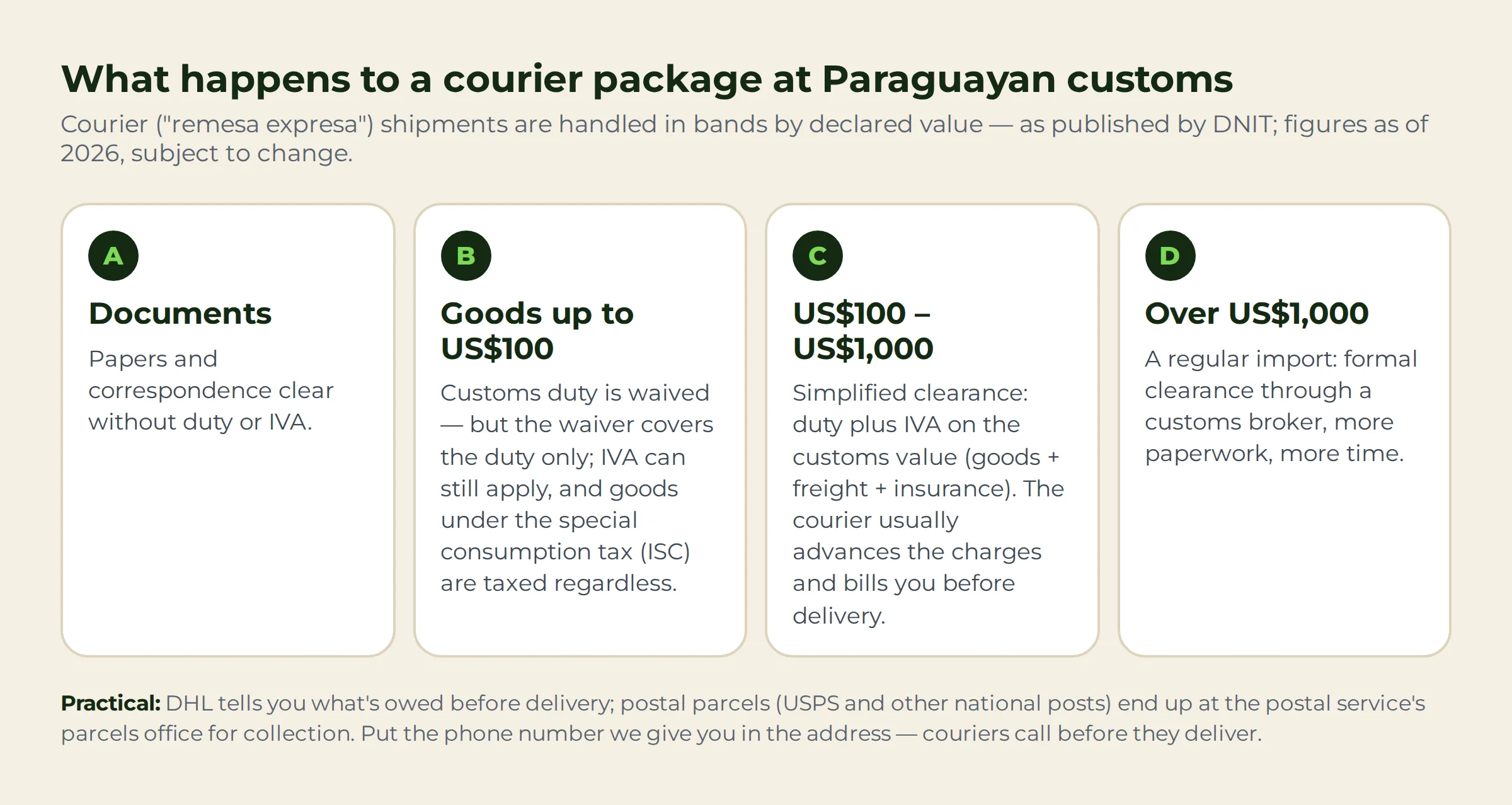
The rules for courier packages are set out in customs resolution 1057/2019, still the framework listed on DNIT’s remesa expresa page as of our last check in 2026. The value bands, in plain language:
- Documents with no commercial value — apostilled birth certificates, police checks, a passport sent for a visa — clear free of customs tax.
- Goods up to US$100 FOB (the value of the goods themselves, before shipping) clear through a simplified channel where the customs duty is waived. Read that carefully: the resolution waives the impuesto aduanero only; IVA and the courier’s processing charges can still show up, so “under a hundred dollars” means “no duty”, not “nothing to pay”. Goods carrying the selective consumption tax — alcohol and tobacco, for a start — go through the taxed channel even under US$100.
- Goods over US$100 and up to US$1,000 FOB clear through the simplified channel with taxes: the Mercosur common external tariff for that product’s classification, plus IVA — currently 10% for most goods, per DNIT — calculated on the customs value, which includes shipping and insurance, not just the price tag.
- Over US$1,000 FOB the package becomes a regular import, filed in the recipient’s name through a customs broker, and time and cost both jump. If you’re ordering something expensive — a high-end laptop, camera gear, a Starlink kit plus accessories — keeping each shipment under the threshold is often the difference between a delivery and a project.
Two honest caveats. The tariff depends on how the product is classified, so nobody — including us — can promise a percentage before the courier files the declaration. And the declared value comes from the sender’s invoice, so a gift with no invoice or a vaguely described marketplace order is exactly the package that gets held while someone asks for paperwork. Give the sender a real description and a real invoice.
DHL: the smoothest door, and what to expect from it
For anything that matters — residency documents, a laptop, a replacement bank card — we tell clients to use DHL, and we use it ourselves for outbound. Not because it’s the low-cost option; because the whole chain is visible. The sequence, as of 2026:
- Tracking that actually updates. You’ll see the package leave, land in Asunción, and enter customs, with email or text updates as it moves.
- Customs messaging. If customs needs something before clearance — usually a proof of identity of the named recipient, sometimes an invoice — DHL sends a link asking for it. We’ve watched packages sit for days because that message landed in spam. If the package is addressed to your mailbox, we forward the link straight to you; it’s your document, and it takes two minutes.
- Duties and taxes, paid before delivery. DHL calculates what’s owed, advances it to customs from its own credit line, and asks you to pay online before the driver comes. Over US$100, expect a payment request; below that, a smaller one or none. DHL adds a processing charge for fronting the money — normal for every courier, not a Paraguay quirk.
- The delivery attempt. Drivers here reach out to the number on the label before they come, usually by text or WhatsApp. If nobody answers and nobody’s there, the package goes back to the depot, and after a couple of missed attempts it can be returned to the sender. This is the most common way a package to Paraguay fails, and it’s preventable (next section).
- Pickup as a fallback. Through DHL’s On Demand Delivery page you can reschedule, redirect, or collect at a DHL service point in Asunción — clients who live outside the capital often hold the package there and grab it on the next trip into town. DHL’s own Paraguay guide makes a recipient mobile number mandatory for hold-for-pickup, which is one more reason the number on the label matters.
One more thing: if a package can’t clear because paperwork is missing, DHL’s Paraguay rate guide says storage charges start from the third calendar day after arrival or after customs’ request, whichever is later. Answer the customs message the day it arrives.
USPS and other postal mail: where the package really ends up
USPS does deliver to Paraguay — Priority Mail International and its faster sibling both operate here per USPS’s own country page — but USPS’s job ends at the handoff. Inside Paraguay the package belongs to Correo Paraguayo. As of 2026:
- Very light items (the postal service’s own 2024 figure is up to about 350 grams) are delivered to the address at no charge under the postal agreements.
- Anything heavier, or anything customs wants to look at, triggers a notice to collect at the postal service’s office — for Asunción, the central office downtown, the Palacio Patri on Alberdi. You bring ID matching the name on the package, customs assesses whatever is due on the spot, you pay a small pickup fee, and you walk out with the box.
- Tracking usually goes quiet between the US and the counter. There’s a Dinacopa tracking app, but expect fewer updates than DHL — you may hear about the parcel from the notice before the tracking page catches up.
- Uncollected parcels are returned to origin after a holding period. Nobody chases you.
For mailbox clients, we collect on your behalf: the notice shows up in your account like any other piece of mail, you tell us to go and get it, and the parcel appears as received, pickup fee passed through at cost.
Two things on the USPS side deserve a red pen. USPS requires the sender to put the addressee’s identity document number or RUC in the “importer’s reference” field, to include the correct postcode, and to attach a commercial invoice to anything containing goods, whatever the mail class — items without them can be returned. And USPS’s prohibited list for Paraguay includes batteries (plus used clothing, wool blankets, leather bags, and most foodstuffs), so a phone or laptop with a lithium battery should go by courier, not through the post.
How to address a package so it doesn’t bounce
Almost every “my package got returned” story we’ve handled came down to one of these:
- Use the phone number we give you. When you activate the mailbox, you get a local number for every shipping label. Couriers contact it before attempting delivery; a package with a foreign number, or none, goes back to the depot.
- Name exactly as it appears on your account — and on your ID, because a courier or postal clerk will match them. No nicknames, no “c/o” chains, no company name unless the package is genuinely addressed to a company.
- Plain ASCII, no accents. Courier systems strip accents and the label comes out garbled. Write “Asuncion” from the start.
- Include the postcode and, for postal mail, your ID or RUC number. Your cédula or passport number does the job if you don’t have a RUC.
- Declare honestly and describe specifically. “Electronics” invites a customs question; “used personal laptop, model X” answers it. An invoice in and on the box costs the sender nothing.
- Keep single shipments under the thresholds when you can — US$100 for the duty waiver, US$1,000 to stay out of the broker regime.
If a retailer offers to collect estimated import fees at checkout — Amazon labels it an Import Fees Deposit — take it: the courier delivers with nothing to collect at the door, and the retailer refunds any overestimate. Not every retailer or item qualifies for Paraguay, so check before you assume.
What the mailbox does with your package
The Sweet Home Paraguay Mailbox is a correspondence address in Villa Morra that receives envelopes and small parcels — DHL, FedEx, UPS, postal deliveries, Amazon — in your name. Each arrival is signed for, photographed, and posted to your account with a status you can act on: hold it (plenty of clients let a few packages accumulate and collect them in one visit), open and photograph it, or forward it. If a courier needs a signature, we’re at the door; if customs needs something only you can give, such as a proof of identity, we relay the request as soon as it lands.
What the mailbox is not for: freight, pallets, furniture, anything that needs a truck or a customs broker. And since it comes up: the mailbox is a service address, not a residential one — why that matters for the cédula and banking is in mailbox vs. residential address.
Getting a package forwarded to another city or country
Forwarding runs from your account. You keep up to ten forwarding addresses saved — a house in the interior, a family member abroad, a co-working space — each with its own recipient name. On any received item you tap forward, pick the address, and we ship; the tracking number lands back on the same item. The courier cost is yours and is passed through; current pricing for the mailbox itself is on the services page and in the app.
Three routes, by destination:
- Within Asunción, an on-demand local courier — the kind that texts you a driver’s name and a live map.
- Elsewhere in Paraguay, a national parcel carrier with agencies in the interior towns. Rural addresses without house numbers are normal here; a Google Maps pin and a reference (“100 metres past the hotel”) is what the carrier actually wants.
- Outside Paraguay, DHL — tracked, signed for, with the same customs conversation in reverse at the destination, under the receiving country’s rules. That is where the cost varies most.
We forward on your instruction only. Nothing leaves the building because a courier turned up asking for it, and nothing gets opened unless you asked for the contents.
When you don’t need us for this
If you live in Asunción, you’re home during the day, and the retailer collects import fees at checkout, address the package to yourself and skip the middleman. If you’re in the interior and DHL has a service point in your town, hold-for-pickup may beat forwarding. The mailbox earns its keep when you’re not in the country, not reachable, or not keen on couriers knowing where you sleep — and when the alternative is a parcel sitting at the postal counter with nobody to collect it.
Frequently asked
Will there be customs duties if I ship via DHL? Often, yes. Goods over US$100 FOB pay the tariff for their product class plus IVA; under US$100 the duty is waived but IVA and processing charges can still apply; documents pay nothing. DHL calculates it, fronts it, and asks you to pay through a link before delivery. Over US$1,000 you’re into a regular import with a customs broker.
How does USPS delivery to Paraguay work — where does the package end up? USPS hands it to Correo Paraguayo. Very light items are delivered; most parcels wait at the postal service’s downtown office for the recipient to show ID, pay whatever customs assesses plus a small pickup fee, and collect. Mailbox clients can have us do the collecting.
Can the mailbox receive and sign for courier packages? Yes. DHL, FedEx, UPS, and postal deliveries, in your name, signed for and photographed into your account. Customs paperwork that has to come from the named recipient — a proof of identity, typically — we relay to you.
Can I have a package forwarded to another city or country? Yes, from your account: a local courier within Asunción, a national carrier for the interior, DHL abroad. You pay the courier cost; the tracking number appears on the item.
What to do next
If you’re about to ship something to Paraguay and want an address that answers the door, create a free Sweet Home Paraguay account, activate the mailbox, and tell us what’s coming and from where — we’ll tell you which door it’ll enter through and what to write on the label. Then get on with the actual move; the box will find you.