
August 7, 2026 · Updated September 29, 2026 · Tax
US LLC + Paraguay Tax Residency: How the Setup Works in 2026 — and What It Doesn't Do
US LLC Paraguay tax residency in 2026: how a foreign-owned disregarded LLC fits Paraguay's territorial system, which US filings stay, and why US citizens gain nothing.
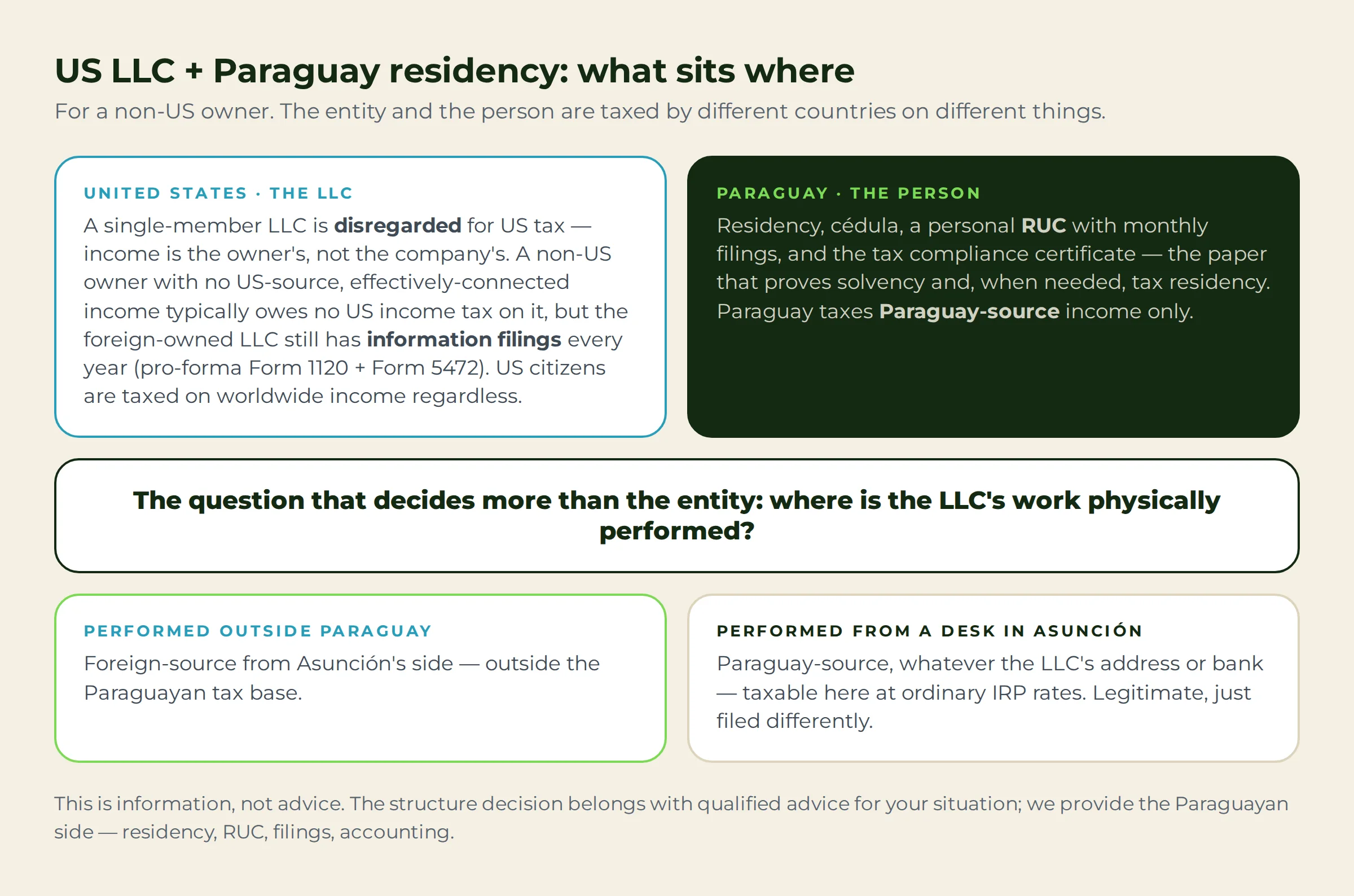
A US LLC plus Paraguay tax residency, for someone who is not a US person, works like this: the United States treats a single-member LLC as “disregarded” — its income is simply yours — and taxes you, a nonresident alien, only on income connected to the US; Paraguay taxes only Paraguay-source income and leaves foreign-source income outside its base. Run a business whose clients, work, and bank accounts sit outside both tax bases and the income-tax picture can be genuinely light. It is not nothing: the US side keeps an information-filing regime with steep penalties, the Paraguayan side needs a real residency, a RUC, and monthly filings before “tax resident of Paraguay” is something you can document, and if you are a US citizen, the structure changes your US tax bill not at all. It is a legal-structure decision that needs qualified advice for your situation. Here is the map, as of 2026, and where we fit in it.
What “disregarded” actually means
For US federal income tax, an LLC with one member is treated as an entity disregarded as separate from its owner unless it files Form 8832 and elects to be taxed as a corporation (IRS). The LLC itself pays no federal income tax; its earnings are treated as its owner’s.
That sentence is the whole logic of the setup, and also its limit. The LLC is a wrapper — limited liability, a US bank account, a contracting party clients recognise — not a tax status. Who you are and where the work happens decide the tax; the wrapper inherits that answer.
The non-US owner: why the US side can be light
If you are not a US citizen, you are a nonresident for US tax purposes unless you hold a green card or meet the substantial presence test (IRS). Owning a US company appears nowhere in that test. A digital nomad in Asunción with a Wyoming LLC is a nonresident alien with a Wyoming LLC.
A nonresident alien’s US tax reaches two things: income effectively connected with a US trade or business, taxed at graduated rates, and US-source passive income — US dividends, US royalties — taxed at a flat 30% by withholding (IRS). Paraguay has no income tax treaty with the United States (IRS treaty list), so no treaty rate lowers that 30%.
The piece that makes the structure work is the source rule for services: personal service income is sourced where the services are performed, regardless of where the contract was made, where payment is made, or where the payer lives (IRS). Consulting delivered from a desk in Villa Morra to a client in Texas is, for US purposes, foreign-source income — even though a US LLC invoiced it.
That income only becomes taxable in the US when it is tied to a US trade or business — the classic trigger being you or staff performing services inside the United States on a considerable, continuous, and regular basis (IRS) and, depending on the facts, a US office or inventory in US warehouses. If the LLC is not engaged in a US trade or business and you have no other US-source income, there may be no US income tax return for you to file; if it is engaged in one, you file Form 1040-NR on that income. That “if” is the entire question, so confirm it for your facts rather than assuming it from a forum.
US payers and platforms will ask you to certify your status; because the LLC is disregarded, that is your own Form W-8BEN in your name (the LLC goes on the reference line), not a W-9. And “light” describes income tax. It does not describe paperwork.
The US paperwork that does not go away
This is the part the “US LLC + territorial-tax country” pitch skips, and the part that costs real money.
Form 5472 with a pro forma Form 1120. Since 2017, a US LLC wholly owned by a foreign person has been treated as a reporting corporation for information-reporting purposes. It has no income tax return of its own, but it must file a pro forma Form 1120 with Form 5472 attached every year by the corporate due date, extension via Form 7004 (IRS instructions) — which means the LLC needs its own EIN. Reportable transactions include amounts paid or received in connection with forming, dissolving, acquiring, or disposing of the entity, “including contributions to, and distributions from, the entity”: funding the LLC and paying yourself out of it is exactly what the form is about. The penalty for not filing, or filing something substantially incomplete, is $25,000 per failure, plus $25,000 for each 30-day period the failure continues beyond 90 days after the IRS notifies you — whether or not any US tax was due.
FBAR. The LLC is a “United States person” for foreign-account reporting; LLCs created in the US are named in the definition (IRS). You personally, as a nonresident alien, generally are not — the company is. If the LLC holds accounts outside the US whose combined value tops $10,000 at any point in the year, it files FinCEN Form 114 — due 15 April, automatic extension to 15 October, filed with FinCEN, not with a tax return.
Beneficial ownership reporting. Under a FinCEN final rule that took effect on 14 August 2026, companies created in the United States are exempt from beneficial ownership (BOI) reporting; the requirement now falls on foreign-formed companies registered to do business in a US state, for their non-US owners (Federal Register). This area has moved several times; check FinCEN’s current notice before relying on any summary, ours included.
The state. Whatever state formed the LLC has its own annual report or franchise-tax cycle and its registered-agent requirement — routine, boring, and fatal to the entity if ignored.
The country you left. If you moved from a country that taxes worldwide income, that country’s own exit rules — days, ties, treaty tie-breakers — decide when you stop being its tax resident. A Paraguayan cédula on its own does not do that, and a Paraguayan tax residency certificate helps exactly as far as the other country accepts it. Settle that side with qualified advice before you build anything on top of it.
If you are a US citizen, read this first
Nothing above reduces your US tax. A US citizen is subject to US tax on worldwide income from all sources, and the filing rules are generally the same whether you live in Ohio or Asunción (IRS). Your disregarded LLC lands on your own return as it always did — typically Schedule C — with self-employment tax on top; Paraguay is not among the thirty countries with a US social security (totalization) agreement as of 2026, so no agreement lifts that tax.
The tool US citizens abroad do have is the foreign earned income exclusion: $132,900 for tax year 2026 (IRS), claimed on Form 2555, available if your tax home is abroad and you are either a bona fide resident of a foreign country for an uninterrupted period covering a full tax year or physically present abroad for at least 330 full days in a 12-month window (IRS). It covers earned income only and does not reduce self-employment tax. The foreign tax credit only offsets foreign tax actually paid — on income Paraguay leaves alone, there is nothing to credit — and your Paraguayan bank accounts join your FBAR.
What Paraguay gives a US citizen is real, just different: a calm, affordable country to live in that adds no second layer of tax on your foreign-source income. That is a life decision with a pleasant tax footnote, not a tax strategy. If someone sold it to you as the latter, they were selling.
The Paraguayan side: what has to be real
Paraguay runs a territorial system: only Paraguay-source income is taxed. Personal income tax (IRP) takes 8, 9, and 10% progressively on Paraguay-source personal-services income above the non-taxable floor, a flat 8% applies to local capital income, and companies pay IRE at 10% on Paraguayan-source profits. Foreign-source income sits outside the base. The full mechanics are in our territorial tax explainer.
Where does the LLC’s income sit? Paraguay has no “disregarded entity” concept; from Asunción’s side the LLC is a company formed abroad, with its clients, contracts, and bank accounts abroad, and what reaches you is money from a foreign entity. That is foreign-source income — the reading the whole structure rests on. It gets less clean when the business is, in substance, operating from Paraguay — Paraguayan clients, a local office, local staff. That slice is Paraguay-source and taxable here, and how far DNIT would look past the wrapper for a specific pattern is a question for qualified advice, not for a blog post. We will tell you plainly if what you describe does not sit on one side of the line.
One honest wrinkle that decides more than the entity does: Paraguay sources service income by where the work is physically performed. If you run the LLC’s work from a desk in Asunción, the income from that work is Paraguay-source in Paraguay’s eyes, whatever the LLC’s address or bank — which is why “where will you physically be when you work?” is the first question to settle. Working from abroad and working from Paraguay are both legitimate setups; they are filed differently, and pretending the LLC changes that is where structures go wrong.
“Residency” also means two things here. Immigration residency — temporary residency under Law 6984/22, valid two years, converted to permanent in months 21–24, cédula from Identificaciones — is what lets you live here. It carries a presence rule of its own: you cannot be outside Paraguay for more than 365 days during the two-year temporary period, and Migraciones checks the entry-and-exit record when you file the conversion — a digital nomad’s calendar needs to know that from day one. Tax residency is a documentary fact that DNIT attests: the law defines its personal taxpayers as individuals resident in the national territory, and the certificate process looks at three concrete things: that you hold a RUC, that your filings are current, and, for individuals, that same entry-and-exit record from Migraciones for the period in question, which goes into the file but sets no minimum number of days in the country. That certificate — the Certificado de Residencia Fiscal, under DNIT’s Resolución General 65/2020 — certifies whether you were subject to Paraguayan tax rules for a stated period. It is what a foreign bank or a former tax authority may ask you for; on paper DNIT issues it within ten business days of accepting a complete request, and it is valid for one year from issue.
So the Paraguayan side of a US LLC setup is only real if the RUC is real and the filings are current. A RUC commits you to a monthly Marangatu return — every month, including months with nothing to declare, on the day keyed to your RUC’s digit, with a multa if you miss it (how the monthly cycle works). That filing record, not the LLC, is what makes “I am a tax resident of Paraguay” something you can prove. One planning note: the same RUC, in good standing with its tax compliance certificate, is now the standard proof of economic solvency when you convert temporary residency to permanent — and that file runs on what the RUC has declared, so a RUC that has only ever filed zeros is a different file from one with declared activity. Raise it with us early, not in month 21.
What we do here, and what we don’t
Sweet Home Paraguay is an operations team in Asunción, not a firm that gives tax or legal advice, and what we do for this setup is short. We handle the residency itself — 3–4 months for the residency card plus 1 month for the cédula on the Essential track — and RUC registration at DNIT, with your Marangatu access set up. Our monthly accounting subscription does the filings — every month, zero months included, IVA where it applies, multas settled if one ever appears — in a with-activity tier and a no-activity tier; you hand in receipts through your account, we do the rest. When you need the Certificado de Residencia Fiscal, we obtain it through your account, which is why the RUC has to be active and current first. Current pricing is on the services page and in the app.
What we don’t do: form LLCs, file US forms, opine on Form 5472 or your former country’s exit rules, or tell you whether the structure is right for you. That is qualified advice for your situation, in the relevant jurisdiction, and we say so rather than pretending otherwise. We only hold the documents the Paraguayan side needs; your US and home-country files stay with you. Support is written — chat in the app, WhatsApp, email — in plain terms.
Sometimes the honest answer is that you don’t need us: a US citizen whose only goal is a lower US tax bill will not get it from Paraguay, and we would rather say so in the first message than after an invoice.
Frequently asked
Does owning a US LLC make me a US tax resident? No. For a non-citizen, US tax residency turns on the green card test or the substantial presence test — days physically in the United States — not on owning a US entity. Keep your US days low and documented.
Do I need a Paraguayan company as well? Usually not. The typical shape is a foreign LLC for the location-independent business and a personal RUC in Paraguay for the solvency proof, the tax residency certificate, and any Paraguay-source activity. A Paraguayan company makes sense when you genuinely operate a business here — local clients, staff, premises — a different tax picture (IRE at 10%, plus IDU when dividends leave the company).
Should the LLC open a Paraguayan bank account? There is usually no need. The LLC’s banking usually stays in the US or with a fintech that serves US entities, while your personal Paraguayan account receives what you bring in as personal funds. A foreign account in the LLC’s name puts the company into the FBAR regime once the $10,000 aggregate threshold is crossed. Keep the source separation clean: foreign business income abroad, personal funds here.
Is any of this a loophole? No. A disregarded LLC owned by a nonresident alien is ordinary US tax law; territorial taxation is ordinary Paraguayan tax law. What goes wrong is never the structure — it is missed 5472s, an exit from the old country never actually completed, or Paraguay-source activity dressed up as foreign. Do the filings, keep the substance honest, and the setup is simply what the two systems say it is.
If you run a US LLC, or are weighing one, create a free account and tell us your situation — your citizenship, where your clients are, whether you will have any Paraguayan activity, and whether you are still a tax resident somewhere else. You will get a written, plain answer about what the Paraguayan side needs and, if it applies, an honest “you don’t need us for that.”